Building Community Strength
Creating inclusive, strategic, and fundable plans that deliver tangible results for our communities.
Building Community Strength is a three-year Planning Capacity Training Program delivering financial and technical assistance to ten communities across Maine. The initiative is grounded in Smart Growth and will help communities identify local assets and projects, develop strategic plans, and access necessary funding. By design, this program builds local capacity that will continue to serve communities beyond the span of the program.
Ten communities have enrolled in the program: Calais, Danforth, Enfield, Houlton, Machias, Mexico, Presque Isle, Roque Bluffs, Skowhegan, and Van Buren. Trainees from each municipality will tackle issues such as climate resilience, economic development, farm viability and farmland protection, affordable housing, and equitable and inclusive community development. The program will also train participants in researching and applying for state, federal, and private funding.
Stories of Building Community Strength
Enfield: Persistence, Peers, and a Plan That Finally Passed
Ellen Simone has served on Enfield’s Planning Board since about 2000. For years the board kept putting off updates to the town’s outdated ordinances. In 2016 she began working on them in earnest, including a new land use ordinance that several board members said would never pass.
Then Enfield’s town manager signed the town up for Building Community Strength. As Enfield applied for grants, it hit a wall. Its last Comprehensive Plan dated to 1995 and had never been accepted by the state, which put key funding out of reach. The town was already deep into a new plan when Simone joined the BCS cohort. About eight months later the plan was accepted, and she turned straight to the land use ordinance. Working with residents who had helped shape the comp plan, she brought it to a vote, and it passed.
BCS gave Simone something she had lacked: a network. Each contact could point her to the right person, so she no longer had to build relationships from scratch. Peers mattered too. After a grant writing session in Houlton, Luke Dyer of Van Buren suggested the U.S. Department of Transportation’s Reconnecting Communities Institute, which he thought was ‘tailor made’ for Enfield. The town was accepted and now meets with the program quarterly for resources, training, and mentorship.
“Just 8 months after we started with BCS, our comprehensive plan was accepted by the Municipal Planning Assistance Program (MPAP). Next we tackled the land use ordinance. We got that to pass too, which we’re still reeling from! I can’t believe we did it. This program is invaluable for the contacts and the information, but also the ideas it generated as a result.”
— Ellen Simone, Enfield Planning Board


Machias: Rethinking Lot Sizes for Walkable Housing
Machias is an old town, and residents could walk to many of its services, but there isn’t enough housing in the walkable parts of town. The main obstacle is a minimum lot size of 15,000 square feet, which pushes new homes outward and away from downtown.
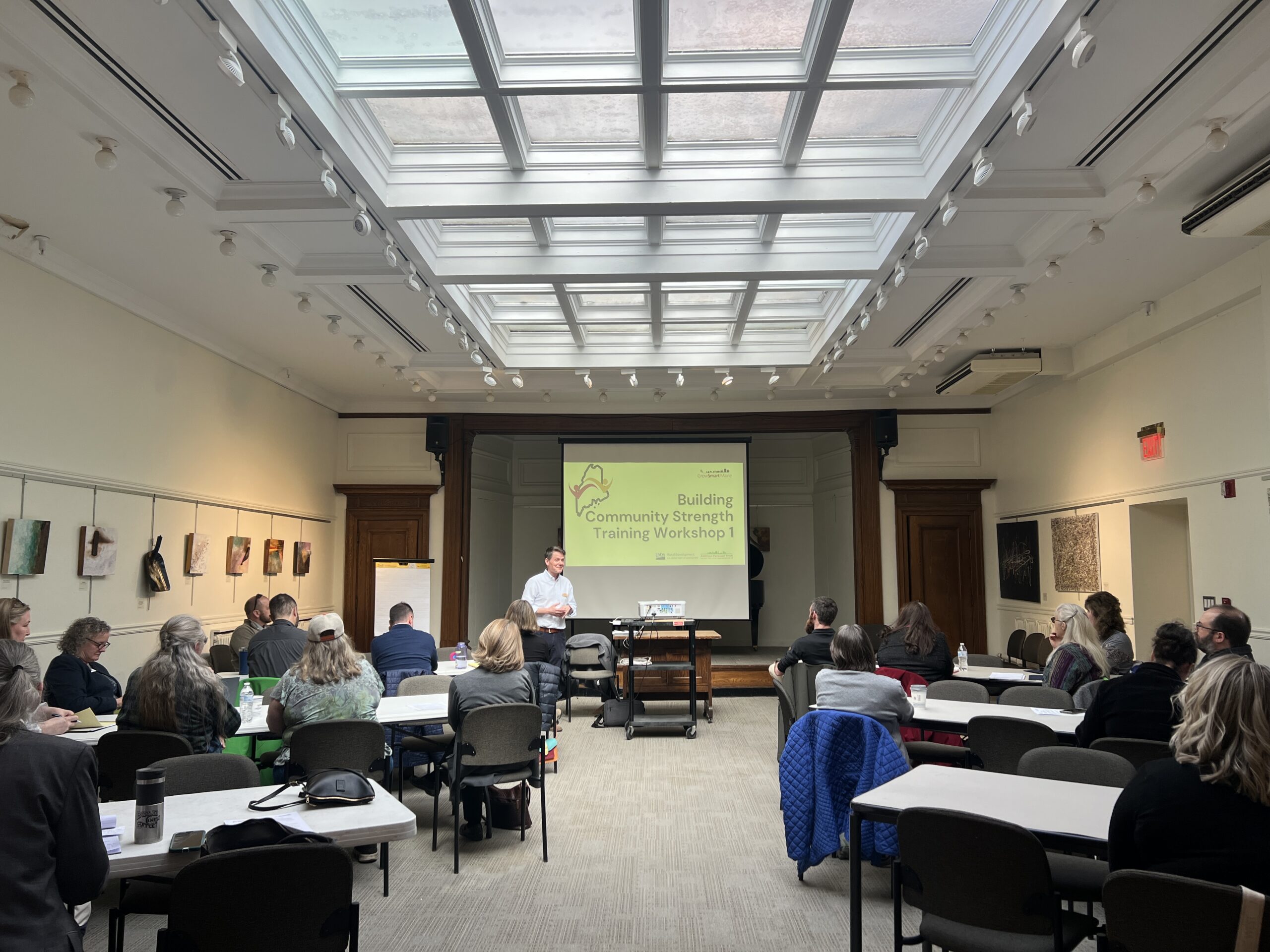
The turning point for Sarah Craighead-Dedmon came at the Building Community Strength workshop held in Machias. Sessions on land use, mapping tools, and Maine’s affordable housing portal changed how she saw local growth. She came away with a message she still repeats: large lots don’t protect rural character. Spreading out erodes it.
Machias is now looking at cutting its minimum downtown lot size, possibly to 5,000 square feet, once its Comprehensive Plan is complete. The goal is to encourage housing downtown, where residents can walk to services. Density would also help the town’s sewer district, which needs more ratepayers to stay affordable.
“One of the big takeaways from the Machias GrowSmart meeting was the usefulness of mixed-use residential and also dense housing. If we don’t start condensing, we’re going to lose that rural character that we thought we were preserving by large lot sizes, but actually you’re destroying a lot of it. All of that language came from GrowSmart.”
— Sarah Craighead Dedmon, Town Manager, Town of Machias
“I had never seen a program like this where a group of communities could get together, learn, and work together to develop a network and not be some entity or organization where you had to be a member of or you had to pay a fee to attend. This three-year program gave us some real tangibles. Those opportunities don’t happen very often, if at all.”
— Nancy Ketch, Community & Economic Development Director, Houlton
The first phase of GrowSmart Maine’s Building Community Strength program ended in the summer of 2026. For the staff members involved, our community partners, and the colleagues who supported the initiative, it felt like an impactful program. We wanted to bring lessons we learned from the program to this year’s Summit.
To expand on the themes of BCS and help generate momentum, we invited three guest speakers for a keynote panel called, Bridging Funding, Capacity, and Local Action. Each of the three speakers brought extensive sector experience and the depth to explore the broader view as well.
Luke Dyer brought his perspective as Town Manager of Van Buren. Denise Smith, Executive Director of the Vermont Council on Rural Development, shared insights and experience from nearby Vermont. Nick Battista, Island Institutes Chief Policy Officer, related the topics to issues facing island and coastal communities, and opened the discussion to federal funding and policy influences.
Looking back upon our work together with the cohort of ten communities, we agreed on three key themes:
- Relationships are the foundation for effective technical assistance. Mutual trust creates a safe, judgment-free space where municipal leaders feel confident sharing real capacity challenges and uncertainties. For small, under-staffed towns, this personal connection is what transforms an abstract, complex resource into something practical, accessible, and worth prioritizing.
- Communities move faster when given tools to define their challenges. Small towns often recognize a problem long before they have the technical vocabulary or planning frameworks to articulate it. Equipping communities to diagnose their own needs makes subsequent technical assistance and funding far faster, more targeted, and more impactful.
- Home rule does not have to mean going it alone. Local independence is strengthened, not compromised, when leaders can draw on the shared experience and networks of neighboring towns. Creating dedicated space for peer learning helps municipalities shift from constant reactive firefighting to proactive, long-term strategizing.
